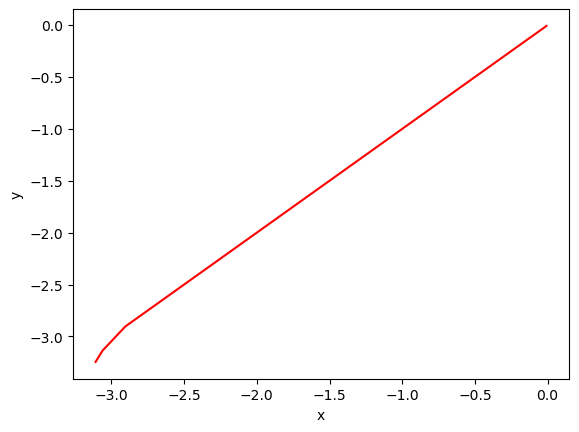
Een van de bekendste voorbeelden van botsende deeltjes in de natuur is Brownian motion. Fijn gemalen pollen in water lijken te dansen in willekeurige richting. Dit komt doordat de pollen worden geraakt door watermoleculen die in alle richtingen bewegen. Omdat de pollen veel zwaarder zijn dan watermoleculen, dus de beweging van de pollen is veel langzamer en minder “intens” dan die van de watermoleculen. Dit proces van willekeurige beweging door botsingen met kleinere deeltjes wordt Brownian motion genoemd en kunnen we simuleren op basis van ons (premature) botsingsmodel. Daarbij kunnen we ook gebruik maken van de zojuist geleerde manier van tracking van deeltjes, waarbij we een zowel het zware bolletjes als een enkel deeltje kunnen volgen.
Let op! We bestuderen hier nog geen thermische effecten, deze opdrachten zijn met name bedoeld om beter te begrijpen hoe het botsingsmodel in elkaar zit.
import numpy as np
import matplotlib.pyplot as plt
# Aanmaken van de randvoorwaarden en initiele condities
Box_size_0 = 10
Box_length_0 = Box_size_0/2
Box_length = Box_length_0 # De grootte van de box kan wijzigen!
# Particles
dt = 0.1
particles = []
N = 40
v_0 = 1
dt = 0.04
# Maken van de ParticleClass
class ParticleClass:
# Het maken van het deeltje
def __init__(self, m, v, r, R, c):
self.m = m
self.v = np.array(v, dtype=float)
self.r = np.array(r, dtype=float)
self.R = np.array(R, dtype=float)
self.c = c
# Het updaten van de positie, eventueel met zwaartekracht
def update_position(self):
self.r += self.v * dt + 1/2 * -9.812 * dt**2
# Harde wand
def boxcollision(self):
if abs(self.r[0]) + self.R > Box_length:
self.v[0] = -self.v[0] # Omdraaien van de snelheid
self.r[0] = np.sign(self.r[0]) * (Box_length - self.R) # Zet terug net binnen box
if abs(self.r[1]) + self.R > Box_length:
self.v[1] = -self.v[1]
self.r[1] = np.sign(self.r[1]) * (Box_length - self.R)
@property
def momentum(self):
return self.m * self.v
@property
def kin_energy(self):
return 1/2 * self.m * np.dot(self.v, self.v)
# Aanmaken van deeltjes
for i in range(N-1):
vx = np.random.uniform(-v_0,v_0)
vy = np.random.choice([-1, 1])*np.sqrt(v_0**2-vx**2)
pos = Box_length_0*np.random.uniform(-1,1,2)
particles.append(ParticleClass(m=1.0, v=[vx, vy], r = pos, R=.5,c='blue'))
particles.append(ParticleClass(m=20.0, v=[0, 0], r = [0, 0], R=.5,c='red')) Er is een doos vol met deeltjes op willekeurige positie aangemaakt. We willen kijken waar de deeltjes zijn terechtgekomen. Hieronder staat dit weergegeven.
# Inspecteren van beginsituatie
plt.figure()

plt.xlabel('x')
plt.ylabel('y')

plt.xlim(-Box_length_0,Box_length_0)
plt.ylim(-Box_length_0,Box_length_0)


for particle, particle_object in enumerate(particles):
    plt.plot(particle_object.r[0],particle_object.r[1],color=particle_object.c,marker='.')
    plt.arrow(particle_object.r[0],particle_object.r[1],
               particle_object.v[0],particle_object.v[1],
               head_width=0.05, head_length=0.1, color='red')
plt.show()
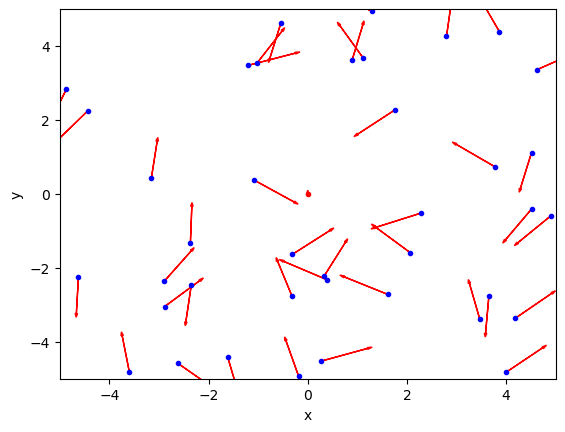
We gaan nu de functies van de simulatie weer aanroepen:
def collide_detection(p1: ParticleClass, p2: ParticleClass) -> bool:
    delta_r = p1.r - p2.r
    delta_v = p1.v - p2.v
    rr = p1.R + p2.R
    if np.dot(delta_r, delta_r) < rr**2:
        if np.dot(delta_r, delta_v) < 0:
            return True
    return False


def particle_collision(p1: ParticleClass, p2: ParticleClass):
    m1, m2 = p1.m, p2.m
    r12 = p1.r - p2.r
    v12 = p1.v - p2.v
    dist2 = np.dot(r12, r12)
    if dist2 == 0:
        return
    factor = np.dot(v12, r12) / dist2
    p1.v -= 2 * m2 / (m1 + m2) * factor * r12
    p2.v += 2 * m1 / (m1 + m2) * factor * r12


#tracken van zware particle
track_x = []
track_y = []
#tracken van lichte particle
track_x2 = []
track_y2 = []

# collision count tracking
collision_count = 0
collision_history = []

#defining a function to count the amount of collisions
def handle_collisions(particles):
    """Return number of particle-particle collisions in this timestep"""
    num_particles = len(particles)
    count = 0
    for i in range(num_particles):
        for j in range(i+1, num_particles):
            if collide_detection(particles[i], particles[j]):
                particle_collision(particles[i], particles[j])
                count += 1
    return count

#loop to update position and count the collisions
for i in range(400):
    for p in particles:
        p.update_position()
        p.boxcollision()

    c = handle_collisions(particles)
    collision_count += c
    collision_history.append(collision_count)

# track particle positions
    track_x.append(particles[N-1].r[0])  #zware particle
    track_y.append(particles[N-1].r[1])
    track_x2.append(particles[0].r[0])    #lichte particle
    track_y2.append(particles[0].r[1])

# plotting particle paths

plt.figure()
plt.plot(track_x, track_y, 'r')
plt.plot(track_x2, track_y2, 'b')
plt.xlabel('x')
plt.ylabel('y')
plt.show()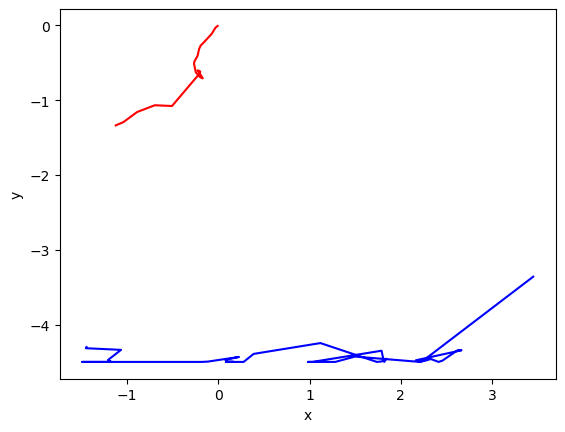
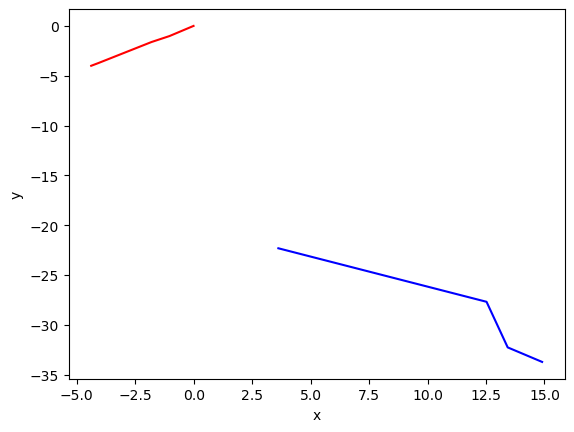
In onderstaande code geven we de code voor de simulatie en volgen we de positie van het zware deeltje.
We zouden gevoel willen krijgen voor het aantal botsingen dat per tijdseenheid plaatsvindt. Elke keer dat er een botsing plaatsvindt, zou de counter met 1 omhoog moeten gaan. Idealiter wordt het aantal botsingen opgeslagen in een array zodat je het aantal botsingen als functie van de tijd kunt weergeven.
#plotting the collision count vs time.

plt.plot(collision_history, 'k')
plt.xlabel('tijd')
plt.ylabel('botsingen')
plt.title('botsingen vs tijd')
plt.show()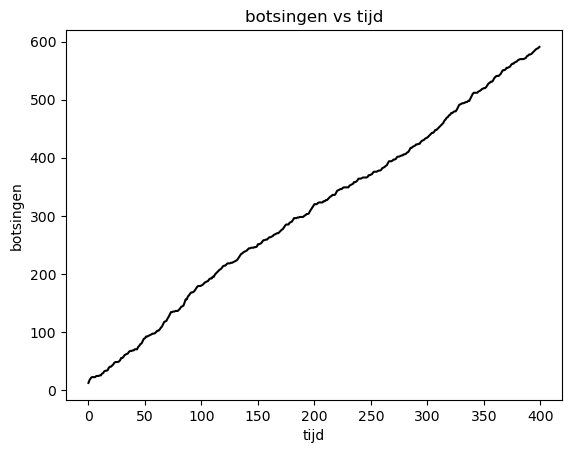
In zulke fysica modellen is de afgelegde weg (afstand tussen begin en eindpunt) van belang. Deze afgelegde weg zegt iets over de snelheid van difussie. Idealiter bekijken we een histogram. Maar voor een histogram hebben we veel deeltjes nodig.
#your code/answer

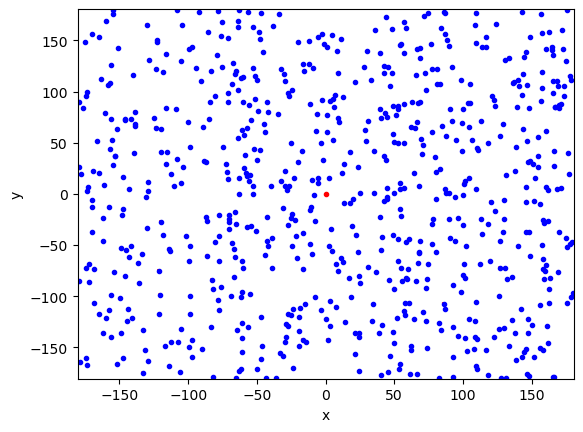
# Aanmaken van de randvoorwaarden en initiele condities
Box_size_0 = 90.25
Box_length_0 = Box_size_0/2
Box_length = Box_length_0     # De grootte van de box kan wijzigen!

# Particles
dt = 0.1
particles = []
N = 361
v_0 = 1

dt = 0.04

# Aanmaken van deeltjes
for i in range(N-1):
    vx = np.random.uniform(-v_0,v_0)
    vy = np.random.choice([-1, 1])*np.sqrt(v_0**2-vx**2)
    pos = Box_length_0*np.random.uniform(-1,1,2)
    particles.append(ParticleClass(m=1.0, v=[vx, vy], r = pos, R=.5,c='blue'))

particles.append(ParticleClass(m=20.0, v=[0, 0], r = [0, 0], R=.5,c='red'))

# Inspecteren van beginsituatie
plt.figure()

plt.xlabel('x')
plt.ylabel('y')

plt.xlim(-Box_length_0,Box_length_0)
plt.ylim(-Box_length_0,Box_length_0)


for particle, particle_object in enumerate(particles):
    plt.plot(particle_object.r[0],particle_object.r[1],color=particle_object.c,marker='.')
    plt.arrow(particle_object.r[0],particle_object.r[1],
               particle_object.v[0],particle_object.v[1],
               head_width=0.05, head_length=0.1, color='red')
plt.show()

#tracken van zware particle
track_x = []
track_y = []
#tracken van lichte particle
track_x2 = []
track_y2 = []

# collision count tracking
collision_count = 0
collision_history = []

#defining a function to count the amount of collions
def handle_collisions(particles):
    #"""Return number of particle-particle collisions in this timestep"""
    num_particles = len(particles)
    count = 0
    for i in range(num_particles):
        for j in range(i+1, num_particles):
            if collide_detection(particles[i], particles[j]):
                particle_collision(particles[i], particles[j])
                count += 1
    return count

#loop to update position and count the collisions
for i in range(400):
    for p in particles:
        p.update_position()
        p.boxcollision()

    c = handle_collisions(particles)
    collision_count += c
    collision_history.append(collision_count)

# track particle positions
    track_x.append(particles[N-1].r[0])  #zware particle
    track_y.append(particles[N-1].r[1])
    track_x2.append(particles[0].r[0])    #lichte particle
    track_y2.append(particles[0].r[1])

# plotting particle paths

plt.figure()
plt.plot(track_x, track_y, 'r')
plt.plot(track_x2, track_y2, 'b')
plt.xlabel('x')
plt.ylabel('y')
plt.show()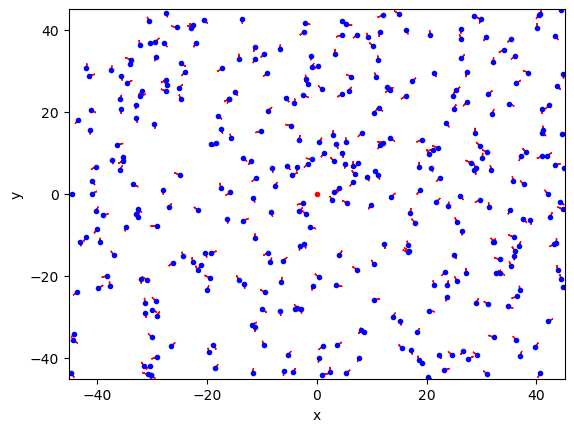
#plotting the routes of the particles in a histogram

plt.hist(track_y2, bins=50, label='lichte particle, y')
plt.hist(track_y, bins=50, label='zware particle, y')
plt.hist(track_x, bins=50, label='zware particle, x')
plt.hist(track_x2, bins=50, label='lichte particle, x')
plt.xlabel('x')
plt.ylabel('y')
plt.title('track of particles')
plt.legend()
plt.show()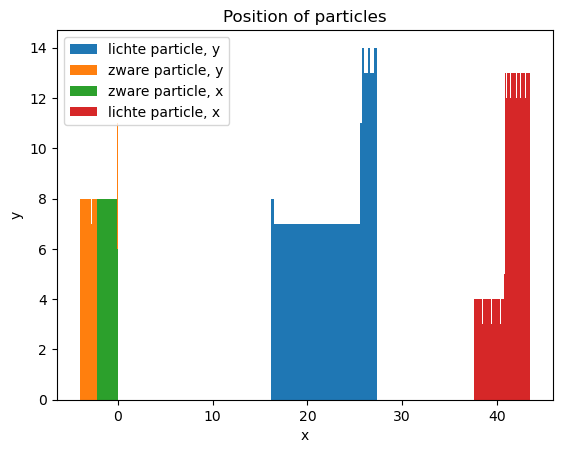
En nu we toch bezig zijn met twee verschillende deeltjes....
We kunnen twee “groepen” van deeltjes aanmaken, elk met een andere massa. Als we dan de zwaartekracht aan zetten, dan zouden we verwachten dat de lichtere deeltjes boven komen “drijven”.
#your code/answer

# Aanmaken van de randvoorwaarden en initiele condities
Box_size_0 = 90.25
Box_length_0 = Box_size_0*2
Box_length = Box_length_0     # De grootte van de box kan wijzigen!

# Particles
dt = 0.1
particles = []
N = 361*2
v_0 = 1

dt = 0.04

# Aanmaken van deeltjes
for i in range(N-1):
    vx = np.random.uniform(-v_0,v_0)
    vy = np.random.choice([-1, 1])*np.sqrt(v_0**2-vx**2)
    pos = Box_length_0*np.random.uniform(-1,1,2)
    particles.append(ParticleClass(m=1.0, v=[vx, vy], r = pos, R=.5,c='blue'))

particles.append(ParticleClass(m=20.0, v=[0, 0], r = [0, 0], R=.5,c='red'))

# Inspecteren van beginsituatie
plt.figure()

plt.xlabel('x')
plt.ylabel('y')

plt.xlim(-Box_length_0,Box_length_0)
plt.ylim(-Box_length_0,Box_length_0)


for particle, particle_object in enumerate(particles):
    plt.plot(particle_object.r[0],particle_object.r[1],color=particle_object.c,marker='.')
    plt.arrow(particle_object.r[0],particle_object.r[1],
               particle_object.v[0],particle_object.v[1],
               head_width=0.05, head_length=0.1, color='red')
plt.show()

#tracken van zware particle
track_x = []
track_y = []
#tracken van lichte particle
track_x2 = []
track_y2 = []

# collision count tracking
collision_count = 0
collision_history = []

#defining a function to count the amount of collions
def handle_collisions(particles):
    #"""Return number of particle-particle collisions in this timestep"""
    num_particles = len(particles)
    count = 0
    for i in range(num_particles):
        for j in range(i+1, num_particles):
            if collide_detection(particles[i], particles[j]):
                particle_collision(particles[i], particles[j])
                count += 1
    return count

#loop to update position and count the collisions
for i in range(400):
    for p in particles:
        p.update_position()
        p.boxcollision()

    c = handle_collisions(particles)
    collision_count += c
    collision_history.append(collision_count)

# track particle positions
    track_x.append(particles[N-1].r[0])  #zware particle
    track_y.append(particles[N-1].r[1])
    track_x2.append(particles[0].r[0])    #lichte particle
    track_y2.append(particles[0].r[1])

# plotting particle paths

plt.figure()
plt.plot(track_x, track_y, 'r')
plt.xlabel('x')
plt.ylabel('y')
plt.show()